
Understanding the Evolution of Modern Digital Pianos
The quest for the best digital piano often begins with recognizing how far instrument technology has advanced over the last few decades. Unlike older electronic keyboards that merely produced artificial tones, modern digital instruments utilize sophisticated sampling technology. Manufacturers record acoustic grand pianos note by note using multiple high-end microphones capturing every acoustic nuance. These digital audio files are then mapped to the internal keys, allowing the instrument to replicate the resonance, harmonics, and dynamic response of a traditional acoustic piano without requiring regular, expensive tuning sessions.
Furthermore, technological integration has transformed these instruments into versatile tools for both traditional practice and modern music production. Most quality digital models feature USB and MIDI connectivity, enabling seamless integration with computer software, notation programs, and virtual studio technology. Players can easily record their performances, practice quietly using headphones during late-night hours, or experiment with secondary instrument sounds like strings, organs, and harpsichords. This duality makes a digital instrument an exceptionally adaptable choice for households where multiple people share the same practice space and musical interests.
The Importance of Weighted Action and Key Feel
When evaluating the best digital piano options on the market, key action stands out as the single most critical factor for serious players. Acoustic pianos utilize complex mechanical wooden levers and felt hammers that create natural resistance, feeling heavier in the lower bass registers and progressively lighter in the upper treble notes. High-end digital instruments replicate this physical sensation through graded hammer action systems, incorporating miniature metallic hammers or authentic wooden keys inside the chassis. This tactile weight is essential for developing proper finger strength, muscle memory, and expressive control over dynamics.
Buyers frequently encounter various terminology when researching keyboard action, ranging from simple spring-loaded keys to fully graded hammer action. Semi-weighted keys are generally found on synthesizers and entry-level portable boards, offering light resistance that suits electronic music production or organ playing. However, piano students and classically trained musicians should strictly look for fully weighted or graded hammer action keys. Without this authentic resistance, transitioning to an acoustic piano later becomes unnecessarily difficult because the fingers fail to develop the necessary articulation required for nuanced phrasing.
Evaluating Sound Engines and Internal Speakers
Sound quality relies entirely on the internal processing power of the instrument and the quality of its built-in speaker system. Advanced digital pianos utilize multi-layer acoustic samples combined with physical modeling to recreate sympathetic string resonance and damper noise. When a sustain pedal is depressed on an acoustic piano, neighboring strings vibrate sympathetically; premium digital sound engines emulate this exact physical phenomenon. Consequently, the resulting sound possesses depth, warmth, and organic realism that cheaper, single-layer sound generators simply cannot match during intricate classical or jazz performances.
Amplification and speaker placement are equally vital considerations that directly impact your daily playing experience. Portable stage pianos often feature smaller downward-facing speakers to maintain a slim profile, which can sound thin when played in larger rooms without external amplification. Conversely, console-style digital pianos house powerful multi-way speaker systems within heavy wooden cabinets that project sound upward and outward, mimicking the soundboard of an upright piano. If you plan to practice primarily through headphones, prioritize models with advanced binaural sampling designed specifically to create a natural spatial soundstage.
Comparing Form Factors and Cabinet Styles
The best digital piano for your specific living environment often depends heavily on physical design and spatial constraints. Portable slab pianos are lightweight, self-contained units that can be easily removed from metal stands, placed in gig bags, and transported to rehearsals, lessons, or live venues. They offer maximum flexibility for musicians who travel frequently or live in compact apartments where floor space is at a strict premium. However, they generally require purchasing a separate sustain pedal, music rest, and sturdy wooden or metal stand to achieve a stable playing setup.
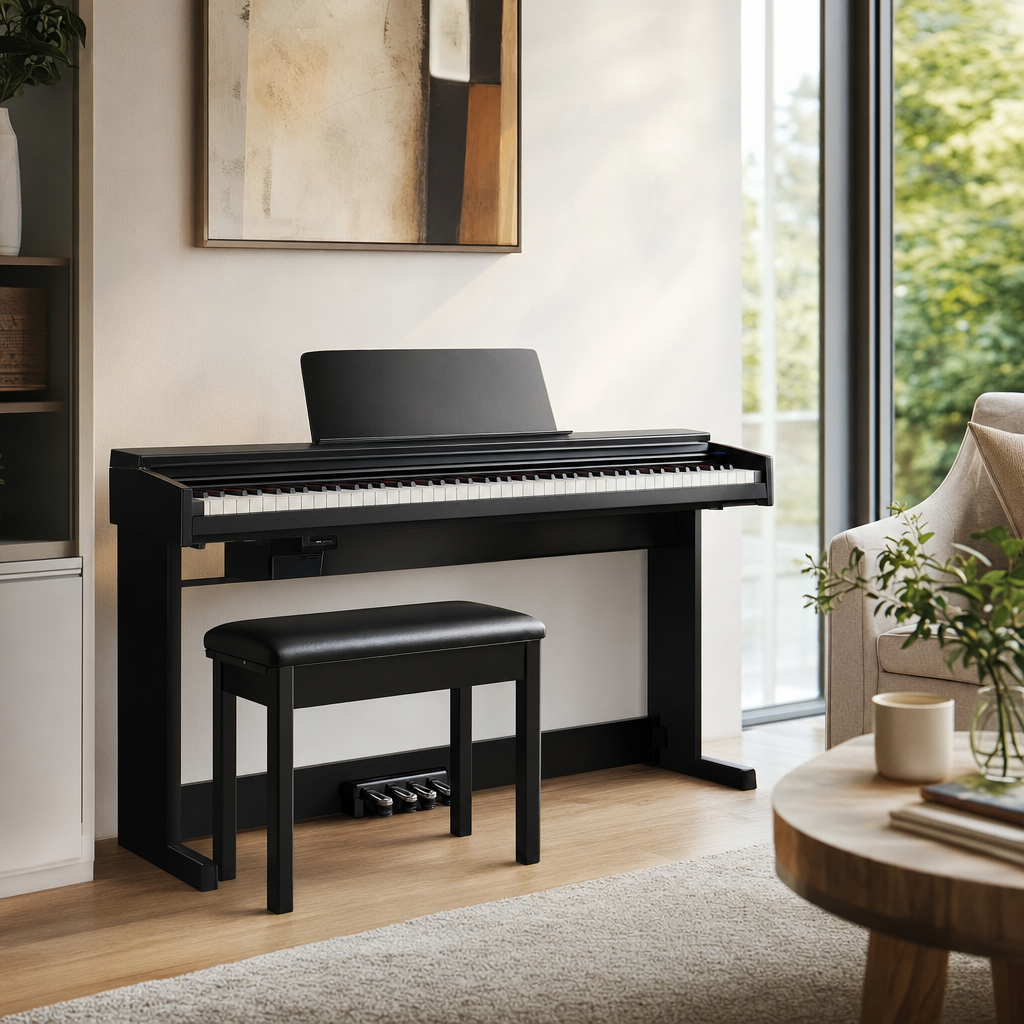
On the other hand, traditional console digital pianos resemble classic upright acoustic furniture, complete with fixed three-pedal units and permanent wooden stands. These heavy units cannot be easily moved once assembled, but they provide superior acoustic cabinet resonance and blend seamlessly into living room decor. Furthermore, console models eliminate setup hassle entirely, making them exceptionally inviting for younger students who might be discouraged by complicated cable management or loose portable hardware. Choosing between these styles requires carefully balancing your need for physical mobility against home aesthetic preferences.
Essential Features and Practical Accessories
Navigating the vast array of available features requires focusing on practical accessories that genuinely enhance your daily practice routine. Every serious player needs a reliable sustain pedal, and while basic footswitches are often bundled in the box, upgrading to a continuous-response pedal enables half-pedaling techniques. Additionally, investing in a high-impedance pair of over-ear studio headphones ensures accurate frequency reproduction during silent practice sessions, protecting your ears while revealing subtle tonal details that standard consumer earbuds miss completely.
Here are key factors to verify before finalizing your instrument selection:
- Ensure the key action is explicitly described as fully weighted or graded hammer action.
- Check that the polyphony count is at least 128 notes to prevent notes from cutting out during complex passages.
- Verify the inclusion or compatibility of a proper three-pedal unit for advanced damper techniques.
- Test the internal speaker wattage or ensure you have budget for external studio monitors if playing in large spaces.
Beyond basic hardware, many modern digital instruments incorporate helpful educational tools like onboard metronomes, dual headphone jacks for teacher-student lessons, and built-in song recorders. Some units even feature wireless Bluetooth audio streaming, allowing you to play along with backing tracks straight from your smartphone or tablet. While these supplementary functions are wonderful conveniences, they should always take a backseat to the foundational triad of key action, sound realism, and build quality when making your final decision.
Frequently Asked Questions
Do digital pianos ever need to be tuned like acoustic pianos?
No, digital pianos never require physical tuning because their sound is generated electronically through digital audio samples or physical modeling algorithms. They will always maintain pitch accuracy regardless of room temperature or humidity changes.
Is it mandatory to buy a fully weighted keyboard for a beginner?
Yes, piano teachers strongly recommend fully weighted hammer action keys for beginners. Unweighted or spring-action keyboards do not build the essential finger strength and muscle memory required for proper acoustic piano technique.
Can I connect a digital piano to music software on my computer?
Most modern digital pianos feature USB-MIDI or standard MIDI ports, allowing seamless connection to computers and tablets. This lets you use digital audio workstations, notation software, and virtual instrument plug-ins with ease.
What does polyphony mean and why is it important?
Polyphony refers to the maximum number of individual notes an instrument can sound simultaneously. Higher polyphony ensures that complex classical pieces utilizing heavy sustain pedals will not drop earlier notes prematurely.
Article Was Generated By AI.