
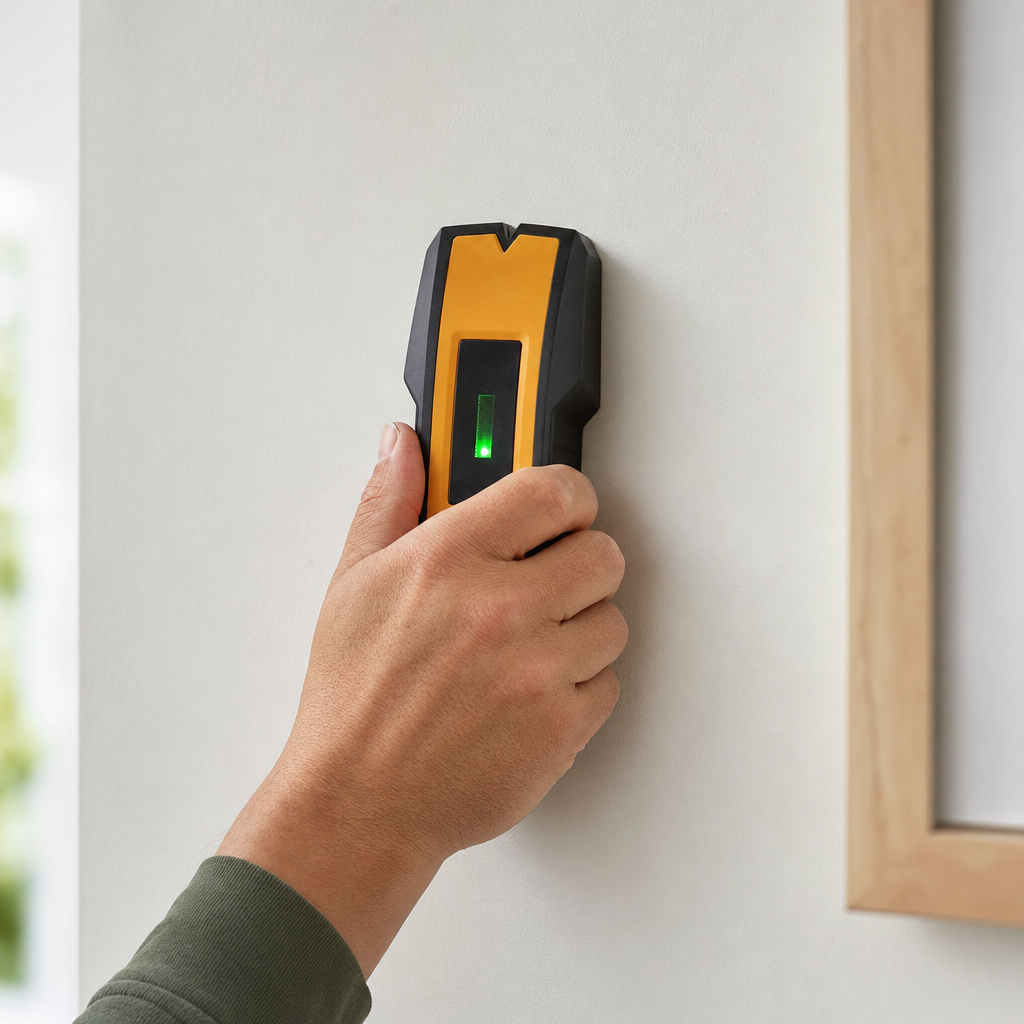
Understanding How Wall Scanners and Detectors Work
When searching for the best stud finder, it helps to understand the underlying technology that allows these handheld devices to see through drywall, plaster, and lath. Wooden and metal framing members behind your walls create a noticeable change in density or magnetic properties compared to the empty cavity space. Traditional mechanical models rely on tiny, pivoting magnets to locate the steel nails and screws that secure drywall to the wooden framing. Because these fasteners are driven directly into the center of the stud, finding them reliably points you to the hidden structural support you need for hanging heavy mirrors, floating shelves, or large flat-screen televisions.
In contrast to simple magnetic attraction, modern electronic stud finders operate by measuring changes in an electrostatic field. As you slide the device smoothly across the surface of the wall, an internal sensor plate monitors the dielectric constant of the material. When the sensor passes over a wooden stud, the density beneath the wallboard changes the electrical capacitance, triggering a visual indicator on an LCD screen or an audible tone. Advanced iterations take this concept a step further by incorporating multiple sensor pads that can map out the entire width of a stud simultaneously, virtually eliminating the guesswork associated with older single-sensor units.
Comparing Magnetic and Electronic Sensor Technologies
Choosing the right tool often comes down to weighing the simplicity of magnetic finders against the advanced features of electronic alternatives. Magnetic models require no batteries, boast a virtually limitless lifespan, and are small enough to slip into a pocket. However, they demand a steady hand and a bit of patience, as you must sweep the magnet slowly back and forth until you feel a gentle tug against the drywall surface. They are exceptionally reliable for finding metal fasteners, but older homes built with wooden lath and plaster can sometimes interfere with magnetic attraction due to wire mesh or numerous iron nails.
Electronic stud finders offer rapid digital feedback, often displaying the exact edges and center of a stud on a digital readout. Many mid-range and professional models also feature live wire detection, a crucial safety capability that warns you when electrical wiring is hidden behind the drywall in your immediate work area. While these battery-powered units provide tremendous convenience, they can sometimes trigger false positives if there is high humidity, thick wallpaper, or fluctuating electrical fields nearby. Understanding these operational differences ensures you select a device that matches your specific household project requirements.
Key Features to Evaluate Before Making a Selection
Evaluating the key features of various wall scanners will help you narrow down the vast array of available options on the market. Depth capability is one of the most critical specifications, especially if your home features thick plaster walls, textured finishes, or double layers of drywall installed for soundproofing. Standard residential units typically scan up to three-quarters of an inch deep, whereas specialized deep-scanning modes can penetrate an inch and a half or more to locate framing members hidden behind heavy exterior-grade wall assemblies or ceramic tile backsplashes.
Ergonomics, calibration methods, and display clarity also play a massive role in user satisfaction during extended home renovation projects. Look for devices featuring comfortable, rubberized grips that prevent slipping when your hands get sweaty, along with bright, backlit screens that remain readable in dimly lit closets, crawlspaces, or unfinished basements. Some advanced units feature automatic calibration upon startup, saving you the hassle of manually tuning the device against an empty section of drywall before every single measurement pass you attempt across the wall.
- Check depth penetration limits to match your specific drywall or plaster thickness.
- Verify if the device offers AC wire warning alerts to prevent dangerous electrical strikes.
- Look for ergonomic, soft-grip handles that reduce hand fatigue during long measuring tasks.
- Consider models with automatic calibration to streamline your scanning process.
Practical Techniques for Accurate Wall Scanning
Even the best stud finder on the market will yield frustrating results if it is not used with proper technique and methodical execution. Before placing the device against the surface, remove any large protruding items and ensure the scanning pad is completely flat against the wallboard. Turn on the unit away from the suspected stud location to let it calibrate properly to the ambient environmental density. Slowly glide the sensor horizontally across the wall without lifting it, paying close attention to the visual or audible cues that indicate the approach of a framing edge.
To achieve maximum accuracy, professional contractors almost always mark both edges of a stud rather than guessing where the center lies. Once the device alerts you to the left edge, make a light pencil mark on the wall, then repeat the process from the opposite direction to locate the right edge. The exact midpoint between these two pencil marks represents the true center of the wooden framing member, providing the most secure anchor point for heavy brackets, cabinets, or heavy shelving units that require maximum structural load-bearing capacity.
Common Challenges and Limitations of Stud Finders
Every homeowner should be aware of the inherent limitations that electronic and magnetic stud finders face in modern residential construction. Plaster walls reinforced with wooden lath pose a notorious challenge because the dense wooden strips spaced closely together confuse electronic sensors into thinking the entire wall is one massive stud. In these older architectural settings, experienced renovators often resort to high-strength rare-earth magnets to pinpoint the nails holding the lath to the underlying structural framing, bypassing electronic interference entirely.
Another frequent hurdle involves modern building materials such as resilient channels, metal studs, or thick foam insulation panels that alter standard density profiles. Metal studs reflect electronic signals differently than traditional timber, requiring a device equipped with a dedicated metal-scanning mode. Furthermore, changes in indoor humidity and moisture trapped behind bathroom or kitchen walls can drastically impact the dielectric properties of drywall, occasionally producing phantom readings that mimic structural framing where none actually exists.
Frequently Asked Questions About Wall Scanners
Why is my electronic stud finder beeping randomly all over the wall?
Random beeping often happens due to lack of calibration, low batteries, or environmental factors like high humidity and electrical interference. Try replacing the batteries, calibrating the device on a known empty spot of drywall, and ensuring your hand is not resting directly on the sensor pad.
Can stud finders detect live electrical wires behind drywall?
Many intermediate and advanced electronic stud finders include AC wire warning features designed to detect active, unshielded alternating current electricity up to a few inches deep. However, shielded cables, metal conduits, or deeply buried wires may not always register, so caution is always advised.
How do I find studs behind thick plaster and lath walls?
Plaster and lath walls are notoriously difficult for standard electronic sensors because of the dense wooden slats. Using a powerful rare-earth neodymium magnet is often the most reliable method, as it will detect the iron nails securing the lath to the structural framing studs beneath.
Should I mark the edges or the center of a stud?
It is always best to mark both the left and right edges of the stud using pencil ticks on the wall. Measuring the exact halfway point between these two edge marks gives you the true center, ensuring your fastener goes directly into the middle of the framing.
Article Was Generated By AI.